
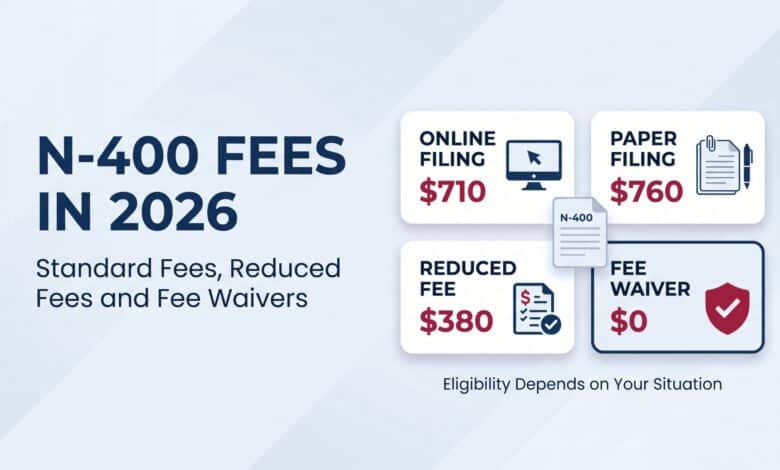
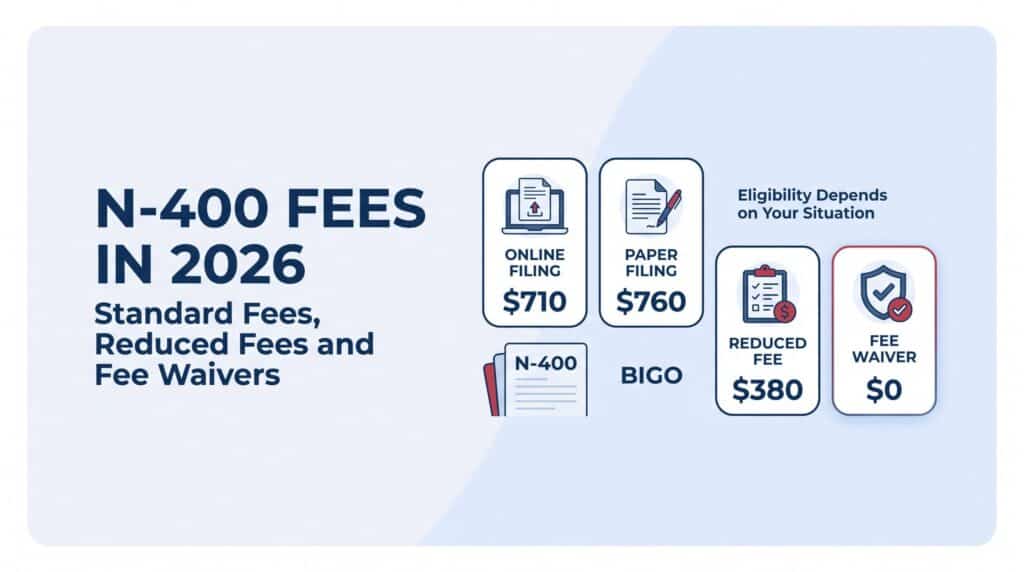
Last verified: September 6, 2026. Form N-400 currently costs $710 online or $760 on paper. A qualifying applicant may instead request the $380 reduced paper fee, a full $0 fee waiver, or—if filing under the qualifying military naturalization provisions in INA sections 328 or 329—pay $0 without requesting a fee waiver.
There is also a major fee proposal pending. DHS proposed raising the standard N-400 fee to $1,280 online and $1,330 on paper while eliminating the reduced-fee option and ordinary N-400 fee waivers. Those proposed amounts are not the current filing fees. As of September 6, 2026, we did not locate a final rule making that proposal effective.
What matters today: pay only the USCIS fee that is in effect on the date you file. Do not send $1,280 or $1,330 merely because those numbers appear in a 2026 news article or proposed rule.
This page is about the cost decision only: which N-400 fee route may apply, how the reduced fee differs from a fee waiver, what evidence/process matters, and what proposed change to watch. For the full eligibility and filing-to-oath journey, use our Form N-400 naturalization guide.
Which N-400 fee applies to you?
Start with the fee path that matches how you are filing and the relief—if any—you are requesting.
| Fee path | Who may use it | How to file under current rules | What the request depends on | Current amount |
|---|---|---|---|---|
| Standard online N-400 | Applicant paying the standard fee and eligible to use USCIS online filing | Online | No reduced-fee or fee-waiver request | $710 |
| Standard paper N-400 | Applicant paying the standard fee by mail | Paper | Correct edition, payment method and filing location | $760 |
| Reduced N-400 fee | Applicant whose documented annual household income is not more than 400% of the applicable Federal Poverty Guidelines and who otherwise follows USCIS reduced-fee instructions | Paper only | Current N-400 reduced-fee section plus supporting income/household evidence | $380 |
| Full fee waiver | Applicant who establishes at least one qualifying USCIS fee-waiver basis | Paper N-400 with Form I-912 or an eligible written waiver request | Means-tested benefit, income at or below 150% FPG, or qualifying financial hardship, with supporting evidence | $0 |
| Qualifying military N-400 | Applicant who meets the naturalization filing category under INA section 328 or 329 with respect to military service | Follow current USCIS military naturalization instructions | Statutory fee exemption; this is not the same as requesting an I-912 waiver | $0 |
N-400 fee proposal: current fee vs. proposed future fee
DHS published the Naturalization Application Fee Adjustments proposed rule on June 23, 2026. The public comment period closed on August 24, 2026. The rulemaking remains a proposal as of this page’s September 6 verification date; no confirmed final rule replacing the current N-400 fee schedule was located in our review.
| Situation | Current rule today | DHS proposal |
|---|---|---|
| Standard online N-400 | $710 | $1,280 |
| Standard paper N-400 | $760 | $1,330 |
| Reduced N-400 fee | $380 for qualifying paper filers | Proposed elimination |
| Ordinary N-400 fee waiver | $0 if USCIS grants the waiver | Proposed elimination |
| Qualifying INA 328/329 military naturalization filing | $0 | Proposal preserves the military fee exemption |
DO NOT PAY THE PROPOSED FEE TODAY.
Current rule: $710 online / $760 paper, with the current $380 reduced-fee and qualifying $0 waiver paths still available.
Proposed change: $1,280 online / $1,330 paper, with the reduced fee and ordinary N-400 fee waiver proposed for elimination.
What to do: check the USCIS Fee Schedule again immediately before filing. If DHS later publishes a final rule, the effective date and transition instructions—not the proposal date—will determine when a new fee applies.
Reduced fee vs. fee waiver: they are not the same thing
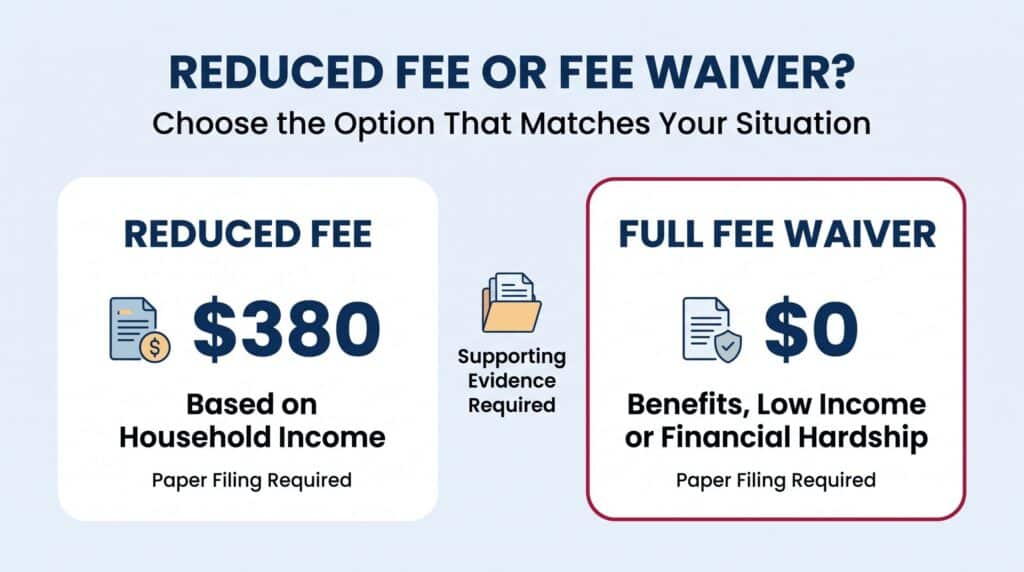
The $380 reduced fee and the $0 fee waiver are two different USCIS processes. They use different legal/financial thresholds and different supporting evidence.
| Question | Reduced fee | Fee waiver |
|---|---|---|
| Current N-400 amount | $380 | $0 if granted |
| Income rule | Documented annual household income not more than 400% of the applicable FPG | Income at or below 150% of the applicable FPG is one possible waiver basis |
| Other non-income basis | The reduced-fee path is tied to the income rule | A qualifying means-tested benefit or qualifying financial hardship may provide another basis |
| Form/process | Use the reduced-fee request in the current Form N-400 and follow its instructions | Use current Form I-912 or an eligible written fee-waiver request |
| Online filing? | No under current N-400 fee rules | No for the ordinary N-400 waiver process under current rules |
| Supporting evidence | Household size and documented annual household income | Evidence supporting the waiver basis selected: benefit, household income, or financial hardship |
| Is qualification automatic? | No | No |
An applicant with income low enough for the income-based waiver may prefer to evaluate the $0 waiver rather than automatically paying $380. But the fee waiver still must be properly requested and documented; this article cannot determine whether USCIS will approve a particular request.
How the 400% and 150% poverty-guideline rules work
USCIS uses the Federal Poverty Guidelines (FPG) as a reference point for the income-based fee routes:
- Reduced fee: documented annual household income must be no more than 400% of the applicable FPG under the current N-400 fee rule.
- Income-based fee waiver: household income at or below 150% of the applicable FPG is one current fee-waiver basis.
Do not save a random dollar threshold from an old article. The actual monetary ceiling depends on household size, the poverty guideline in effect for the relevant filing period, and whether the applicable guideline is for the 48 contiguous states/D.C., Alaska, or Hawaii. Use the current USCIS Poverty Guidelines when preparing the request.
Household size also has a USCIS definition. It is not always identical to “everyone who sleeps at this address.” Follow the current N-400/I-912 instructions and make the household information consistent with the tax and income evidence, or explain legitimate differences.
What can qualify for an N-400 fee waiver?
The current Form I-912 presents three bases for a fee-waiver request. You only need to establish a qualifying basis, but you must provide the evidence required for the basis you want USCIS to consider.
| Waiver basis | What the current rule looks for | Evidence focus |
|---|---|---|
| Means-tested benefit | The applicant, spouse, or head of household living in the household is currently receiving a qualifying means-tested benefit under current I-912 instructions | Current agency notice showing the benefit, recipient and eligibility |
| Household income | Household income at or below 150% of the applicable FPG | Tax/income records and household-size evidence |
| Financial hardship | A current hardship prevents payment of the fee | Records tying the hardship to the present inability to pay—for example, qualifying emergency expenses or other documented financial disruption |
Do not assume that the name of a public program automatically proves the waiver. USCIS looks at whether the benefit and documentation satisfy the current means-tested-benefit guidance and identify the qualifying recipient. Likewise, an income figure or hardship narrative does not guarantee approval without the supporting record.
Use the current Form I-912 and instructions rather than relying on a benefit list copied from an older website. The Form I-912 PDF verified for this update is Edition 07/22/25; recheck the USCIS page before filing in case a later edition becomes mandatory.
Online vs. paper filing: the $50 discount is only one part of the decision
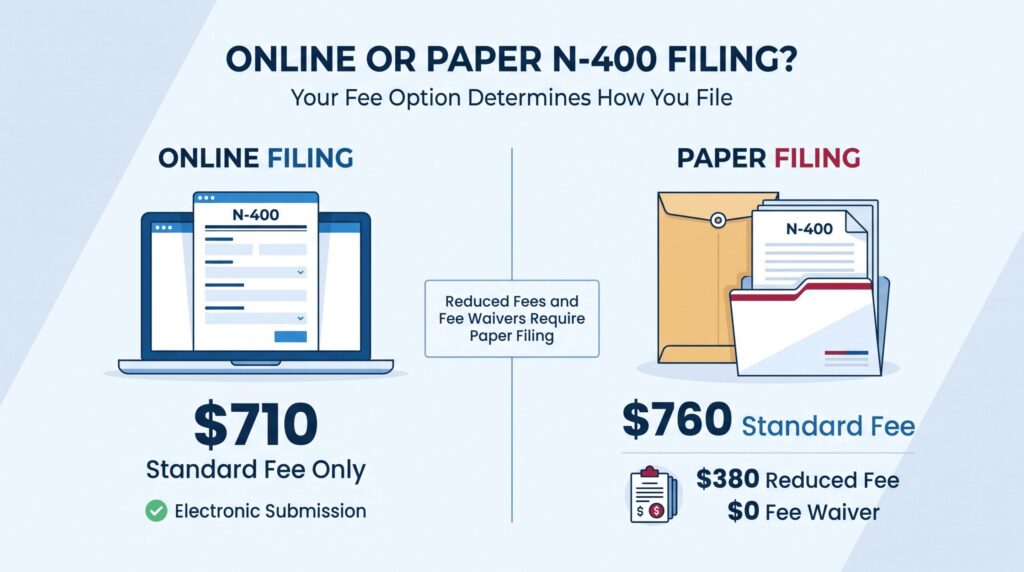
A standard N-400 filer currently saves $50 by filing online: $710 instead of $760. But applicants requesting the current $380 reduced fee or a full fee waiver must use the applicable paper process.
| Filing choice | Fee | Can request reduced fee? | Can use ordinary N-400 fee-waiver process? |
|---|---|---|---|
| Online N-400 | $710 | No | No |
| Paper N-400, standard fee | $760 | Not applicable | Not applicable |
| Paper N-400, reduced fee | $380 | Yes, if the request qualifies | No—this is the reduced-fee path |
| Paper N-400 with fee-waiver request | $0 if USCIS grants the request | No—this is the waiver path | Yes |
The cheapest option is the lowest-cost option you are actually entitled to request—not automatically the online discount. If you qualify for the reduced fee or waiver, filing online at $710 simply because it feels easier can cost more than necessary.
Is there a separate N-400 biometrics fee?
No separate biometrics service fee is added to the current N-400 filing amount. USCIS incorporated biometric-services costs into the filing-fee structure.
That does not mean every applicant will have an identical biometrics step. USCIS may reuse biometrics already in its systems or may schedule collection when appropriate. The N-400 fee does not decrease merely because USCIS reuses prior biometrics.
Payment errors can still cause rejection
A correct fee category can still fail at intake if the payment cannot be processed or the filing is submitted with the wrong amount. USCIS transitioned most mailed benefit-request payments to electronic authorization methods in 2025; the current payment guidance includes Form G-1450 for card payments and Form G-1650 for ACH payments, with limited paper-payment exceptions.
Before mailing, confirm the payment method accepted for the filing location, the exact amount, the current authorization form, and whether your bank or card issuer will permit the transaction. USCIS states that an application can be rejected when the required fee is incorrect or payment fails.
Verify the current Form N-400 edition too
The official Form N-400 PDF checked on September 6, 2026 displays Edition 01/20/25. Do not let a correct fee accompany an obsolete form edition. Recheck the USCIS N-400 page immediately before filing because form acceptance rules can change.
This fee page intentionally does not repeat the naturalization eligibility, residence, civics-test, interview, or oath rules. For those issues, use the main N-400 naturalization guide. If you are organizing the records USCIS may expect for filing or interview, use our naturalization documents checklist.
What to verify immediately before paying USCIS
- Check whether the June 2026 proposed fee rule has become final. As of September 6, it has not.
- Open the current USCIS G-1055 Fee Schedule. Do not rely on a search snippet, old screenshot, or future proposed amount.
- Choose the correct fee path: $710 online, $760 paper, $380 reduced fee, $0 fee waiver if granted, or qualifying military $0 exemption.
- If requesting a lower fee, use the current poverty guidelines and household definition. Do not copy last year’s dollar threshold.
- If requesting a waiver, use the current I-912 instructions and evidence for the basis you are claiming.
- Confirm the N-400 edition and paper-payment method. Correct fee + obsolete form or failed payment can still cause rejection.
The fee decision should be simple once those checks are complete: pay the amount USCIS requires for the filing path you actually qualify to use on the day you file—not the amount a proposed rule might require later.